Communication & Presentation
How to Open a Business Presentation: 6 Patterns That Work
How to open a business presentation in the first 30 seconds — 6 patterns (number, question, story, statement, contrast, ask) and what never to open with.
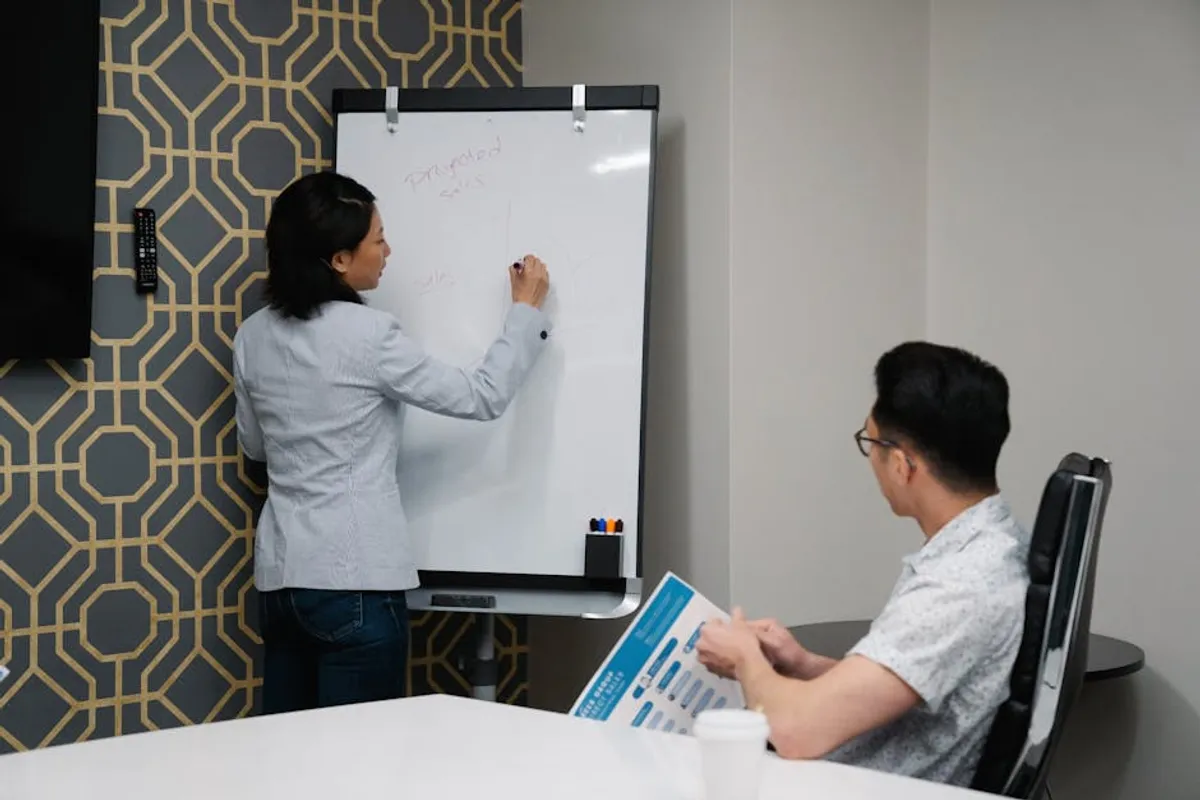
The three things that decide whether your presentation opening lands or wastes the most valuable 30 seconds of your slot: (1) never open with “thank you for your time.” (2) Pick one of 6 patterns that hand the audience something interesting in the first sentence. (3) State your purpose by second 45. Skip any one and the audience has already mentally checked out before slide 2. Patterns below.
If you have ever watched a presenter spend the first 90 seconds thanking the chair, reading the agenda aloud, and apologising for the technology — you have seen the most expensive 90 seconds in business presentation. After 24 years of training working professionals in Singapore, I can tell you the gap between presentations that earn the room and presentations that have to claw the room back is almost always the first 30 seconds.
Here is a useful way to think about it. The opening of a presentation is like the first frame of a movie. The audience decides whether to invest the next 90 minutes — or to start checking their phones — in the first 30 seconds. The skill is making that 30 seconds interesting enough that the audience is glad they came. This article gives you the 6 ways.
1. Why the first 30 seconds decide
Three structural truths:
- Audience attention is highest at the start. Then it declines steadily for 8-12 minutes before stabilising. The opening sits at the peak.
- First impressions of credibility form fast. Roughly 30 seconds of speaking is enough for an audience to judge whether you’ll be worth listening to.
- Recovery is expensive. A weak opening means you spend the next 5 minutes climbing back into the room’s attention. Most presenters never recover fully.
Get the opening right and the rest of the talk runs downhill.
2. The 6 proven opening patterns
Six patterns that work in business settings. Pick by topic and audience.
1. The heroic number. “$4.2 million. That’s the cost of the supplier issue we discovered last quarter — and what we’re proposing to recover today.”
2. The direct question. “How many of you have approved a contract this year that you later regretted? [pause] By the end of this 15 minutes I’ll show you why that happens — and what to change.”
3. The 30-second story. “Three weeks ago, our largest supplier sent us this email… [paraphrase the email] …that single line started the work I’m here to share.”
4. The bold statement. “The way we’ve been forecasting demand for the last 5 years is wrong. Today I’ll show you what we found and what to do about it.”
5. The contrast. “Last quarter our peers grew 8%. We grew 2%. The next 12 minutes is about the gap — and how to close it.”
6. The ask itself. “I’m asking the executive committee to approve $200k for the supplier consolidation pilot today. Three slides on why it matters and how it works.”
Each pattern grabs attention through a different mechanism — surprise, curiosity, narrative, conviction, contrast, clarity. Pick the one that fits your topic. Don’t mix patterns; pick one and commit.
The same destination-first discipline drives structuring a business presentation and presenting to senior leadership — open with substance, never with throat-clearing.
3. What never to open with
Six openings that read as junior or wasteful:
| Don’t open with | Why |
|---|---|
| ”Thank you all for your time today” | Generic; signals junior |
| ”I’m Mei from the analytics team…” | Audience knows; wastes attention |
| Reading the agenda aloud | Repeating the slide; insulting the audience’s literacy |
| ”Apologise in advance for the slides…” | Don’t apologise for what you’re about to show |
| ”Sorry the system is being slow” | Pretend the tech is fine; address only if it really fails |
| ”Before I start, a few housekeeping notes” | Housekeeping is not an opening |
Cut these. Permanently. The same junior-vs-senior distinction shows up in Steve Jobs’s openings — Jobs opened with substance, not gratitude.
4. The 60-second opening template
Three sentences. Three jobs.
Sentence 1 — The hook. Pick from one of the 6 patterns. Sentence 2 — Why it matters now. One specific reason this matters in the next 60 days, not abstractly. Sentence 3 — The roadmap. “In the next [X] minutes I’ll cover [3 things], then take your questions.”
That’s the entire opening. 45-60 seconds. Then straight into the body.
5. Calibrating for audience type
Different audiences need different opening patterns.
| Audience | Best pattern | Why |
|---|---|---|
| Senior executives | The ask itself (#6) | They want destination first |
| Mixed business + technical | The heroic number (#1) | Concrete; lands across functions |
| External clients | The 30-second story (#3) | Builds rapport faster |
| Conference / industry | The bold statement (#4) | Earns interest in a competitive attention environment |
| Internal team | The direct question (#2) | Pulls them in; signals dialogue |
| Board / investors | The contrast (#5) | Frames the strategic stake |
The same audience-calibration logic drives presenting to senior leadership — read the room before you pick the open.
6. Practising the opening
The opening is the part of the talk most worth rehearsing. Steve Jobs rehearsed openings dozens of times. TED speakers report doing the same. Most working professionals rehearse the opening once.
A practical drill:
- Write the opening verbatim. Three sentences, written.
- Read it aloud, on your feet, 5 times.
- Time it. Should be 45-60 seconds.
- Memorise the first sentence completely. The next two can be slightly improvised.
Memorising sentence 1 is the trick. The first sentence is when nerves are highest; muscle memory carries you through. The same rehearsal logic drives presentation lessons from Steve Jobs.
A pattern from the training room. I once worked with a manager preparing a quarterly review for the board. We watched her rehearsal: the opening was 90 seconds of thanks, agenda, and a self-deprecating joke. We rewrote it as 3 sentences — heroic number, why-now, roadmap. She protested for 5 minutes that “the board likes a warm-up.” She tried it. The board’s body language at sentence 1 was visibly different — heads up, pens down, listening. She told me afterward she’d never had a board meeting feel that engaged. After 24 years of training, the same lesson: boards reward respect for their time. Wasted seconds at the open compound across the meeting.
7. The transition from opening to body
Don’t fade into the body. Mark the transition explicitly.
“That’s the why. Here’s how we get there. [pause]” “With that as the context, let me walk you through the three steps.” “That’s where we start. Now the proposal.”
A clear transition signals structure to the audience and resets attention into the body of the talk. The same structured-presentation discipline — section transitions named, not implied — applies.
The natural sequence: pick the pattern → draft 3 sentences → rehearse 5 times → memorise sentence 1 → deliver in 45-60 seconds → transition cleanly into the body.
Pick the smallest move — rewriting your next opening as one of the 6 patterns — and try it. Delivering Impactful Business Presentations (WSQ) is the 2-day course version. SkillsFuture credit eligible.
Hero and in-body images via Pexels.
Frequently asked
How should I start a business presentation?
Pick one of 6 proven patterns: a heroic number, a direct question, a 30-second story, a bold statement, a contrast, or the ask itself. Never open with thanks, the agenda, or apologising for being there. Section 2 covers each pattern.
What's the worst way to open a presentation?
*'Thank you all for your time today.'* Three reasons it fails: it's generic, it signals junior, and it wastes the highest-attention moment of the talk. Section 3 covers what never to do.
How long should the opening of a presentation be?
60 seconds maximum. The audience decides whether to invest in the rest of your talk in the first 30 seconds; the second 30 seconds either confirms or loses that interest. Section 4 has the template.
Should I introduce myself at the start of a presentation?
Briefly — name, role, and *one specific reason you're the right person to present this*. Skip the full CV. Most presenters over-introduce themselves and waste 90 seconds.
How do I open a presentation when the audience already knows me?
Skip the introduction entirely. Open with the substance — a number, a question, or the recommendation. The audience knows who you are; demonstrate that you respect their time by skipping what they already know.
Is there a course version of this article?
Yes — Delivering Impactful Business Presentations (WSQ) is the structured 2-day course where a trainer rehearses your opening with live feedback. SkillsFuture credit eligible.
About the author
Vinai Prakash
Founder & Principal Trainer, SoftSkills.sg
Vinai has trained 48,000+ working professionals across 12,600+ companies in Singapore over 24 years. He is ACTA-certified, holds a PMP, has an MBA in eCommerce, and authored Excel Crash Course (BPB Publications). All trainers at Intellisoft Training are ACTA or DACE certified with 20–25+ years of industry and teaching experience.
Related reading
More on communication
How to Build Confidence for Public Speaking: A 6-Week Ladder
How to build confidence for public speaking: a 6-week ladder protocol, body-before-mind physiology, the 60-second pre-talk ritual, and how to recover.
How to Communicate with Clients: 4 Phases, 6 Habits
How to communicate with clients across the full relationship — 4 phases (pitch, kickoff, delivery, renewal), 6 habits, and channel discipline.
How to Disagree at Work: 4 Scripts That Don't Burn Bridges
How to disagree at work without damaging the relationship — a 3-step structure plus 4 scripts (boss, peer, client, group meeting). Singapore tone-calibrated.
Want the full curriculum, outcomes and upcoming dates? See our Communicate With Confidence (WSQ) course page, or browse all soft skills courses.
Prefer hands-on coaching with live feedback in the room? Book the Communicate with Confidence (WSQ) — WSQ-funded and SkillsFuture-claimable, run by Vinai's training team.