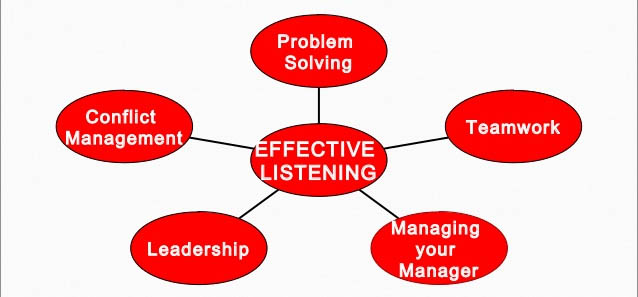
Soft skills covers a pretty large area, ranging from Problem Solving Skills, Communication Skills, Listening Skills, Leadership Skills, Time Management Skills, Stress Management Skills, Customer Service Skills, Motivating Skills, Negotiation Skills… just to name a few.
If you try to do too many things at the same time, you won't succeed at anything. So it may be better to focus on 1 or 2 of these skills which you think you are weak at, or would like to improve further. This keeps the objective clear and you can then focus to achieve it.
One of the biggest skill that you must master is to be good at Communications… with your colleagues, your subordinates, your bosses, vendors, friends, family members, pretty much every one you usually come in contact with.
Communication goes much deeper than simply speaking skills… although acquiring great speaking skills alone is not easy.
To communicate effectively and efficiently, you must be able to talk and listen attentively. Then put across your points concisely. Many people only want to talk and keep the control of the discussion to themselves, so they keep interrupting people when others are talking. This is not effective at all, and can lead to poor communications, and even a break-down in communications.
To become a good communicator, you must practice doing communication as much as possible. You can't become an expert at communication simply by reading books on this topic, or thinking abotu it. You must practice it… just like swimming, and you'll get better at it once you are able to break out of your comfort zone.
I recently wrote about a few key Soft Skills that you must learn:
- Shut Up & Listen to Be More Effective
- How Good Are Your Soft Skills?
- How to Achieve Work Life Balance
One of the best ways to improve your Communication skills is to join a Toastmaster's club. There will be several in your town or neighborhood. In Singapore, a small city, there are over 100 clubs, and you can easily find one that meets on a weekend, or a particular weekday you are free.
The meetings are usually for 1-2 hours, once to twice a month. It is a gathering of like minded people who want to improve their speaking and listening skills. You have to speak (prepared speech or impromptu), and critique someone else's speech.
It is an excellent way to learn in a very non-threatening way. I have improved my speaking skills by attending these early on in my career, and even started to win the Best Speech in my club several times.
Give it a try. I am sure you will improve a lot of your soft skills, specially your communication, public speaking, listening skills. You'll also find a mentor or friend who could help you further your goal of improving your communication and other soft skills.
Soft skills like Communication, Time Management, Stress Management, Negotiation Skills and Motivational skills are all inter-linked.
As you become better in one area, you will feel more confident, and will feel ready for the next challenge... to improve in another area.
You can never become a master of any soft skill... they are more of an art. But you can become better, and more effective... which is what we want to achieve. Simply sign-up for short courses to improve your soft skills, and begin to learn the hidden secrets of effective communications, effective time management, and effective work-life balance.
Hope this will motivate you to get started in your journey of life-long learning!
Which Soft Skills Should You Focus On First?
Most working professionals in Singapore who ask how to improve soft skills are juggling at least four overlapping skill areas at once. Trying to improve all of them in parallel is the fastest way to improve none of them. Pick one as your anchor for the next 90 days:
- Communication skills — writing clearly, speaking with structure, and reading the room. The highest-leverage skill for most office roles. Start with our guides on how to write professional emails and how to speak confidently in meetings.
- Listening skills — the underrated half of communication. Most people listen to reply, not to understand. The fix is mechanical: don't speak for the first 10 seconds after someone finishes.
- Time management — protecting deep work, killing low-value meetings, and finishing what you start. The Pomodoro technique covered in how to achieve work-life balance is the simplest entry point.
- Goal setting — turning vague intent into something your brain can actually act on. See how to achieve your goals for the SMART framework.
- Stress & emotional management — the meta-skill that keeps the others from collapsing under pressure.
- Negotiation & influence — quietly compounds across your career; matters more than people realise.
If you're not sure which one to pick, ask three colleagues you trust: "What's one soft skill you wish I were 20% better at?" The answer that comes up twice is your anchor.
A Simple 7-Day Plan to Improve One Soft Skill
Improving soft skills is a practice problem, not a knowledge problem. Reading another article (including this one) is not the unlock — deliberate, repeated practice is. Here is a 7-day starter loop that works for any of the skills above:
- Day 1 — Define. Write down the one skill you're improving and what "20% better" looks like for you in concrete terms. Example: "I want to run my weekly team meeting in 25 minutes instead of 50, with clearer decisions."
- Day 2 — Observe. Watch yourself once. Notice where you currently fall short — interrupting, drifting, hedging, going quiet. Don't try to fix it yet.
- Day 3 — Pick one micro-habit. Just one. Pause 2 seconds before replying. Send the agenda the night before. End every meeting with a written decision.
- Day 4–6 — Practise daily. Use the micro-habit at least three times a day. It will feel awkward; that's the signal it's working.
- Day 7 — Review. Honestly: did the micro-habit move the needle? Keep it, swap it, or add a second one for next week.
Repeat this loop for 12 weeks and you will be measurably better at one skill. That's faster than 95% of professionals will ever improve at anything in their career — because most people read, nod, and never run a single deliberate rep.
Common Mistakes When Trying to Improve Soft Skills
- Trying to improve everything at once. You'll bounce between skills and never compound on any of them.
- Treating it like a course you can finish. Soft skills are a practice, like swimming or playing an instrument. There is no graduation date.
- Skipping feedback. Without honest feedback from people you work with, you'll calibrate to your own bias and plateau.
- Confusing intensity with consistency. One six-hour course beats nothing, but ten minutes of daily practice beats one course every time.
Attend a Soft Skills Workshop in Singapore
Communicate with Confidence (WSQ)
The most popular starting point for working professionals in Singapore who want to improve their soft skills fast. WSQ-accredited, partially funded for eligible Singaporeans, and built around live practice — not theory. Covers communication, listening, public speaking and influence in one workshop.
Or call +65-6250-3575 · training@softskills.sg
Frequently Asked Questions
What are the most important soft skills for working professionals in Singapore?
Communication, listening, time management, and the ability to disagree without burning relationships. These four cover roughly 80% of what office work in Singapore actually rewards. Everything else — leadership, negotiation, executive presence — is built on top of those four.
How long does it take to improve a soft skill?
You can see a noticeable change in 12 weeks of daily practice on one skill — not by reading more, but by running deliberate reps (one micro-habit, three times a day). A 1-day WSQ workshop accelerates the start; the compounding still happens between sessions.
Can soft skills really be taught, or are they personality?
They are taught the same way swimming is taught — by doing the thing, getting feedback, adjusting, and repeating. Personality affects your starting point, not your ceiling. Every introvert in our workshops has improved at public speaking; none of them turned into an extrovert. The two are unrelated.
Are soft skills courses in Singapore funded by SkillsFuture or WSQ?
Yes — most of our flagship soft skills courses are WSQ-accredited and SkillsFuture-claimable for eligible Singaporeans and PRs. Corporate participants can also tap PIC and absentee payroll where applicable. Confirm eligibility with us before enrolling so we can route you to the funding that applies.
Should I learn soft skills online or in a classroom workshop?
Online video is fine for the knowledge half — the frameworks, the vocabulary, the why. The practice half (speaking under pressure, handling pushback, listening when you'd rather talk) only develops in a room with other humans giving you live feedback. That is what a workshop buys you that a video cannot.
Written by: Vinai Prakash
Vinai is the founder and principal trainer at SoftSkills.SG. He has trained hundreds of companies across 23 countries in improving productivity, getting more done and achieving balance in their lives. Vinai lives in Singapore.